

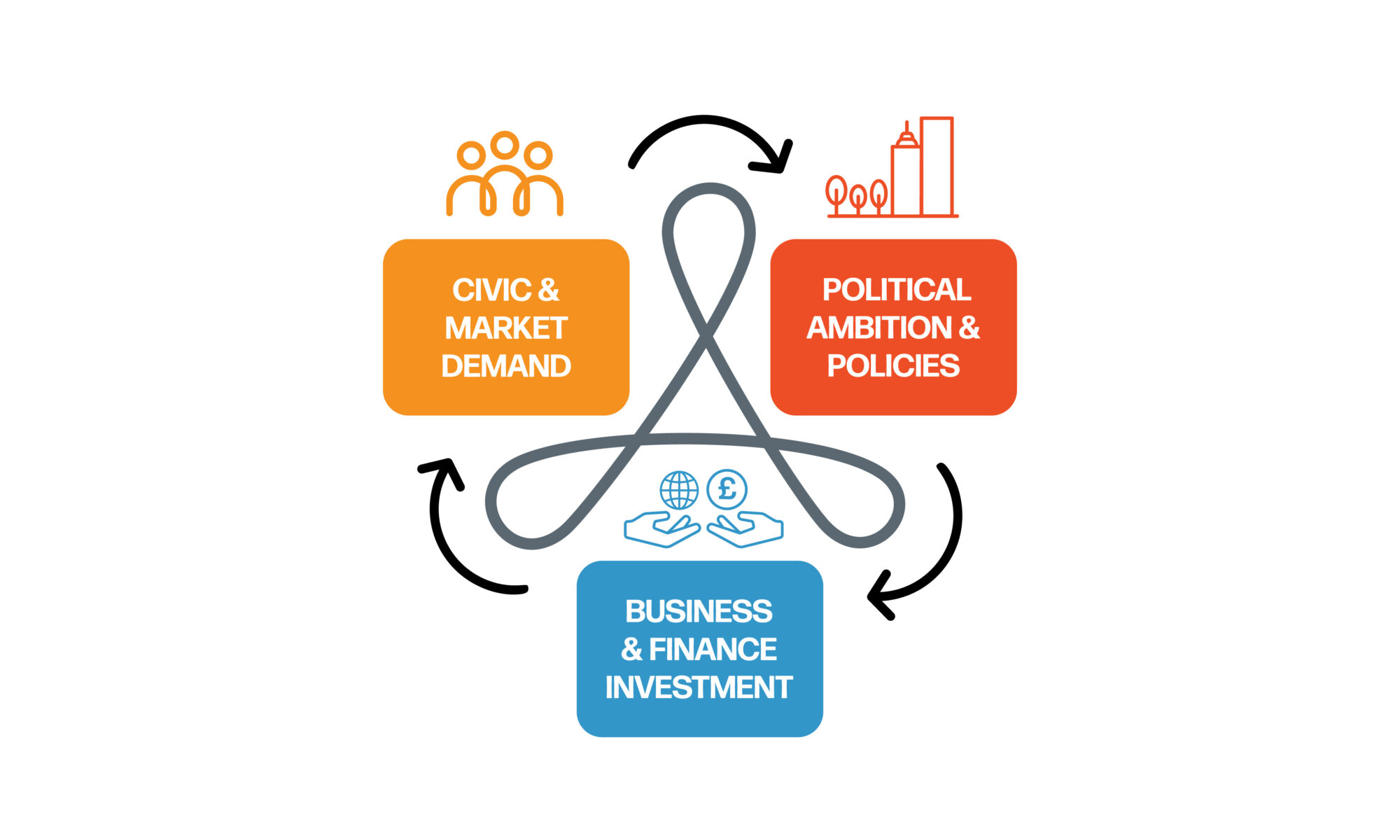
An Ambition Loop is a model for a reinforcing feedback loop between three key stakeholders in a system:
- Community — individuals and groups living or working in the system.
- Business — organisation providing a service or a product.
- Government — bodies that provide oversight and governance.
When the interests of these three stakeholders align, they can form a virtuous circle that enables this system behaviour to propagate. In the Pattern Book, the ambition loop motif is one of our establishing tests for the viability of a policy or business strategy.
Why Ambition Loops matter to policy and strategy
Systems resist change. Design that parachutes in a new idea without reference to the needs of the existing system is risky. There is a high chance that the system will reject a new idea unless it helps actors in the system meet their needs better than they already can.
The Ambition Loop model provides a useful conceptual test: does your idea align these key stakeholder interests enough for the system to take it up?
Example of Ambition Loops in practice: pioneering doorstep recycling
The development of doorstep recycling in the UK wasn’t centrally driven, but was pioneered at local scale, and in particular by local activists from Avon Friends of the Earth, a local-level campaigning organisation.
The context
In the 1970s, manufacturers were shifting towards using more disposable packaging and ending, for instance, bottle take-back schemes. Meanwhile, public awareness of environmental issues and the problem of waste to landfill was growing. The UK government judged doorstep recycling to be too expensive to implement. Avon Friends of the Earth saw the opportunity to prove otherwise.
Although they didn’t frame it in these terms, we can see retrospectively that they were able to establish an Ambition Loop between three stakeholder groups that enabled their interests to align.
- Local community — increasingly concerned about the impact of waste, with awareness heightened by the rubbish collection strikes at the time.
- Business — local businesses willing to buy waste paper as a feedstock if they could get their hands on a supply.
- Local council — saw that local waste disposal costs were rising and the government faced the challenge of high levels of unemployment.
Minimum viable pattern: small-scale collection
In 1976, Avon Friends of the Earth began small-scale waste paper collections that collected household paper waste door-to-door and sold it to a local business that could use this material stream. Environmentally-minded business entrepreneurs collaborated to guarantee a market for recycled paper, helping to get the system moving. They used the government’s Community Programme, which provided temporary jobs for the long-term unemployed through community-based projects, to pay the workforce. This simple loop of public interest, business opportunity and alignment with government objectives made the system viable and even profitable.
Increasing scale
Over many years, recycling initiatives grew in scale and the success of these initiatives gave government evidence that they could confidently legislate for recycling. This activity culminated in the adoption of the 2003 Household Recycling Act, which made doorstep recycling a legal requirement for local authorities.
This example shows that when a simple, reinforcing loop — what we call an Ambition Loop — is set up, it has the power to change a system. But also, that this change can take years, and even decades.
User guide
Step 1 – Identify the stakeholder groups
- Users: Who are the customers or public involved? What are their desires? What are their pain points? How is the current system failing them?
- Businesses: Which businesses are involved? What are their priorities? What barriers do they face? What shift in operating conditions would make business better?
- Government and regulation: Which public bodies are involved? What are their ambitions? What challenges are they seeking to overcome? What in the policy landscape is a blocking change?
Step 2 – Draw a self-reinforcing loop with arrows
- Try connecting up the stakeholder groups in different combinations to find mutual benefit.
- Draw an arrow showing how the action of each stakeholder benefits the next stakeholder in the loop.
- How might the loop become self-reinforcing over time, so that the change can gather momentum?
Step 3 – Find the minimum viable pattern
- What is the smallest scale that an ambition loop can be demonstrated?
- Who could you test this minimum viable pattern with?
- How can you gather evidence that this loop is working?