
In the Pattern Book we sweep together terms like values, beliefs and ethics and gather them under the broad term ‘mindsets’.
Mindsets have high leverage in the system (see the System Bookcase). They shape operating systems and design decisions. They also take a long time to change. Working at the level of mindsets therefore has great potential but should also be approached with patience.
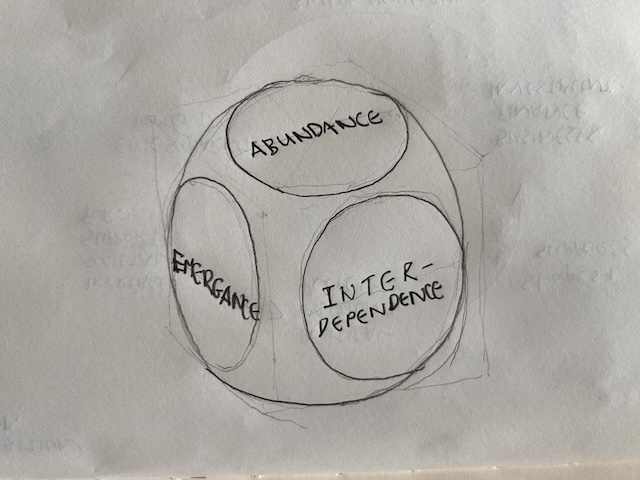
In The Regenerative Structural Engineer, we suggest that shifting to regenerative practice requires a shift in mindsets from three that are commonly held in our current economy to three associated with a more holistic world view.
- From separation to interdependence
- From scarcity to abundance
- From control to emergence
These mindset shifts are characterised in the table below.
From Separation to Interdependence
| Separation | Interdependence |
| I see myself as independent from the system I am working in | I see myself as dependent on the system I am working in |
| The health of the system has no impact on me | My health and the health of the system are inseparable |
| ‘I was stuck in traffic’ | ‘I was traffic’ |
From Scarcity to Abundance
| Scarcity | Abundance |
| There is no potential in the system | There is potential in the system |
| There isn’t enough for everyone | The system can meet everyone’s needs |
| I must protect my surplus to meet my needs in the future | If I give away my surplus I will always have enough to survive |
| ‘If I look after myself, I will be fine’ | ‘If I look after the system, I will be fine’ |
From Control to Emergence
| Control | Emergence |
| I know the best options | The best options may not be clear to me |
| The best solutions will come from thinking about the problem in isolation | The best solutions will emerge |
Role in the Pattern Book
Changing mindsets is one the most commonly used motifs in the Pattern Book because it serves so many functions — both as an early tool for engagement and for supporting on-going reflection:
- an early entry point to surface existing mental models
- a philosophical grounding for the more structural systems-based motifs
- an empathetic framing for working with resistant audiences see also Three Horizons > Understanding Group Dynamics
- a persuasion tool — helping audiences to notice their own perspectives and to experiment with seeing the world from an alternatives
- a framing tool — for long-term business plans, infrastructure strategy or policy
- inspiration — challenging assumptions and sparking new ideas
- a way to interrogate values in decision-making
- prompts for personal reflection
User guide
Exploring your own mindsets
- Where do you personally identify as sitting on each of these three mindset spectra?
- In a work or project context, where do you sit? Is it different from where you personally identify?
- What other mindsets or values influence your decision-making?
Look for the mindset in the system
- Take a design decision, strategy or policy. Ask, what mindset shaped it?
- Then ask what it would look like if it were shaped by a different mindset?
- If you have populated a Systems Bookcase as part of another exercise, ask what mindsets have shaped the books on the operating shelf?
Exploring values in decision-making
- What values do I bring to decision-making?
- What values do others I consult bring to decision-making?
- What values are embedded in the tools and processes we use?
→ for more on values related to decision-making see Framing the Question.